
Written by

Marissa Jambrone
Director, Marketing
Laboratory leaders carry a weight that most people outside the field don't fully appreciate. You're accountable for documentation, competency, corrective action, inspection evidence, and consistent standards — all at once, often with a team that's stretched thin. The compliance work never stops, even when everything else does.
What makes that weight manageable for some labs and relentless for others isn't aptitude or effort. It's infrastructure. The tools a lab has in place either distribute the compliance work across daily operations — or concentrate it into high-stakes preparation cycles that consume the team every two years.
This article examines the dynamics of the 'second model,' why it persists even in high-performing labs, and the necessary steps to cultivate the first.
TL;DR: CAP conducts subsequent inspections within a 90-day window, and deficiency responses are due within 30 calendar days of inspection (College of American Pathologists). Nearly 60% of lab professionals report experiencing burnout, with compliance pressure among the leading drivers (Harris Poll / Siemens Healthineers). The labs that move through inspection cycles without disruption haven't necessarily worked harder at preparation — they've built systems that make everyday inspection-ready.
Why Inspection Preparation Still Feels Like a Project
Inspection readiness creates stress not because lab leaders are underprepared, but because the compliance infrastructure most labs operate with was designed for a simpler time.
CAP maintains 21 discipline-specific accreditation checklists that are updated annually to reflect advances in laboratory medicine and evolving regulatory expectations (CAP, 2025). As a result, the compliance landscape shifts slightly every year. Documentation systems that passed inspection two years ago may have gaps today — not because anything changed within the laboratory, but because the standards themselves have evolved. Keeping pace with those changes manually places an ongoing burden on the individuals responsible for managing the laboratory’s quality program.
The burden becomes most visible around competency assessment. While the core CLIA competency requirements have remained largely stable over time, regulatory interpretations and accreditation expectations continue to evolve through updates to CAP checklists and other guidance. Despite being a long-standing requirement, competency assessment consistently ranks among the most cited deficiencies in CAP inspections. (CAP / LabSymplified).
That persistence across inspection cycles is not a sign that laboratories misunderstand the requirements. Rather, it reflects the reality that many of the tools labs rely on to track competency were never designed to manage the full cycle reliably — ensuring evaluations occur at the right intervals, notifying the appropriate supervisors, and producing clear documentation that aligns with what inspectors expect to see.
This isn't a criticism of how labs operate. It's an observation about what the tools were built to do. A spreadsheet is a flexible, familiar tool — and it's genuinely useful for a lot of things. Maintaining a defensible, timestamped audit trail across six CLIA-required competency assessment methods for every testing employee and test method, with automated reminders, reassessments and electronic acknowledgment, is not one of them.
When the regulatory landscape changes — and in 2025, CMS rolled out the first major CLIA updates in decades — labs managing compliance manually absorb that change through manual work. Someone must read the update, assess the gap, revise the tracking system, communicate the change to staff, and monitor change effectiveness. In a well-resourced quality function, that's manageable. In a lab where the leaders are handling all the quality initiatives and projects or even working on the bench on top of it, it's another weight added to an already heavy load.

The Real Cost of Reactive Inspection Cycles
Every lab that has been through a CAP inspection cycle knows the rhythm: a long quiet period, followed by an intensifying period of preparation as the anniversary date approaches. Evidence and files get organized. Documents get reviewed. Staff acknowledgments get chased. Gaps are identified and assigned for correction.
That preparation is real work, and it reflects genuine care for the lab's accreditation status. The challenge isn't the effort — it's what reactive preparation can't protect against.
The defensibility gap. Experienced inspectors recognize the difference between an evidence trail that accumulated over 24 months of disciplined daily operations and one that was pulled together under time pressure. Version mismatches, acknowledgment records that thin out between cycles; corrective actions closed without substantive evidence — these patterns are visible to an inspector who has seen them before.
The evidence trail that stops short. Continuous compliance means continuous evidence. CAPAs rushed and closed the week before the inspector arrives doesn't demonstrate that the lab's corrective action process works — it demonstrates that someone was paying attention when inspection was imminent. The most defensible labs produce evidence trails that are uniform across the entire accreditation period, not concentrated just prior to inspection windows.
The human cost. This one is often left out of the compliance conversation, but it belongs here. Nearly 60% of lab professionals report experiencing burnout, with heavy workloads and compliance pressure among the leading contributing factors, according to a Harris Poll survey commissioned by Siemens Healthineers. Over 80% report burnout symptoms across surveys, with understaffing as the most common driver (CLP Magazine). Inspection preparation cycles that spike the workload of your most quality-focused staff every two years don't just affect accreditation outcomes — they affect retention, and retention affects everything else.
The intent behind reactive preparation is always sound. The limitation is structural.

What Continuous Inspection Readiness Actually Looks Like
Continuous inspection readiness doesn't mean the lab is always in inspection mode — it means the lab operates in a way that produces inspection evidence as a natural byproduct of daily work.
Three things make that possible in practice.
Standardized workflows that build evidence automatically. When a competency assessment is due, the system assigns it to the right person and sends the reminder — without a Quality Manager or Lab Educator tracking the calendar manually. When a document expires, the review cycle opens automatically and routes to the appropriate periodic reviewer. When an event is reported, it connects to a corrective action workflow that tracks phased steps, assignments, closure, ongoing evaluations while recording timestamps for every step.
Centralized documentation with enforced version control. A single source of truth for every policy, SOP, form, job aid, and more means every staff member is working from the current versions — not a saved copy from 14 months ago. Electronic acknowledgment workflows create the attestation record CAP inspectors look for. When a policy is revised, the old version is archived and the new one requires formal approval before it becomes active. Staff don't have to remember to check for updates. The system ensures the right version is the only version accessible.
Audit trails that accumulate rather than get reconstructed. The most defensible inspection evidence is the kind that was never assembled for inspection at all — it was created continuously as a record of how the lab operates. Every competency assessment, every acknowledgment, every NCE and CAPA and all metadata over 24 months. That's what continuous readiness produces: an operating record.
On the regulatory side, it's worth noting one recent development: in June 2025, CAP and The Joint Commission reached an agreement permitting up to 14 days advance notification for laboratory inspections to better align CAP inspections with hospital accreditation survey policies. That's a meaningful change for some facilities. But follow-up inspections and complaint-triggered inspections remain unannounced (CAP newsroom, June 2025). And for the many labs not operating under TJC hospital accreditation, the window remains the same: subsequent inspections arrive without advance notice. Labs that depend on notification to begin their preparation are still in a reactive posture, regardless of that change.
How the Right System Reduces Risk and Improves Defensibility
There's a distinction worth drawing carefully here: the difference between documented compliance and defensible compliance.
Documented compliance means records exist. A spreadsheet with competency assessments listed. A shared folder with policy PDFs. An email thread that eventually resulted in a corrective action being closed. These things constitute documentation — but they don't constitute a defensible audit trail, because they weren't produced through a system designed to create one.
Defensible compliance means records are current, complete, user-attributed, and produced through a process that an inspector can trace. The competency assessment wasn't just completed — it was completed via a structured workflow that logged which assessment method was used, when it was conducted, who administered it, and what the assessment revealed. The corrective action wasn't just resolved — the resolution was documented with closure evidence inside the system that assigned it. The policy acknowledgment wasn't just emailed — it was received, recorded, and reportable with a timestamp and 21 CFR part 11 compliance.
That distinction matters to CAP inspectors who have seen both kinds of documentation. It matters to Lab Directors who want their quality program to reflect the care their team puts into it. And it matters practically: when the evidence speaks for itself, the inspection becomes a confirmation of what the lab already knows about its own compliance posture, rather than a test it hopes to pass.
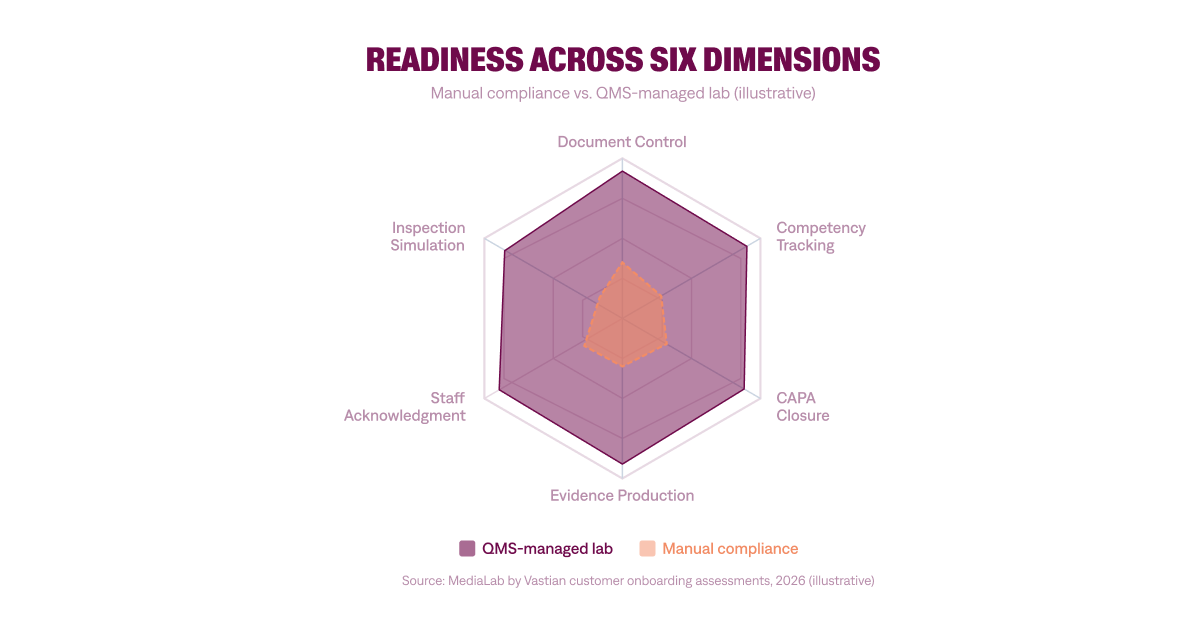
What to look for in a lab compliance platform: automated competency scheduling across all CLIA-required assessment methods, document review and approval alerts with electronic acknowledgment workflows, closed-loop NCE and CAPA tracking with ongoing evaluation of effectiveness documentation, and native inspection evidence production — no manual data export required. These aren't advanced features. They're the baseline for a system built specifically for regulated laboratory environments.
Moving from "Passing" to Confidently Prepared
There's a meaningful difference between a lab that passes a CAP inspection and a lab that passes confidently — and it's not the outcome. It's the experience of getting there.
A lab that has been managing compliance reactively and passes an inspection has done something real and commendable. The preparation happened, the evidence was assembled, the team delivered. And afterward, there's often relief — alongside the knowledge that the cycle will start again. The inspection was cleared, but the underlying dynamic didn't change.
A lab operating in continuous readiness experiences the same inspection differently. The documentation was already organized. The evidence trail was already current. Staff knew where things were because that's how they operate on a Tuesday in November, not because an inspection was two weeks out. When the call came, the response wasn't "start preparing" — it was "we're ready."
That shift—from preparing for inspections to staying ready all the time—changes more than just the inspection experience. It frees quality managers and lab leaders to spend less time preparing for audits and more time strengthening the laboratory’s quality program. It changes what staff turnover means for compliance continuity: when institutional knowledge lives in the system rather than in the person, a departure doesn't create a gap. It changes the Lab Director's relationship with the accreditation cycle: instead of a high-stakes event to survive, it becomes a confirmation of how the lab already operates.
The labs under the highest regulatory scrutiny in the country have made this shift. All Top 10 U.S. clinical labs and all Top 20 U.S. hospitals operate with MediaLab by Vastian — 9,500+ facilities across 60+ countries. Not because those organizations don't face compliance pressure, but because at that scale, operating any other way isn't sustainable.
"When inspectors ask their questions, your team doesn't hesitate. Everyone knows where the evidence lives and trusts that it is current. That confidence doesn't come from scrambling before an inspection — it comes from disciplined systems that support daily work." - Leah Westover, MPH, MLS(ASCP, CPHQ, VP, Client Success at Medialab by Vastian
For labs that want to see how always-on readiness is structured in practice, see how labs maintain continuous inspection readiness through MediaLab by Vastian.
Frequently Asked Questions
What is required for CAP laboratory inspection?
CAP laboratory inspections assess compliance with discipline-specific accreditation checklists — 21 in total, updated annually to reflect current standards (CAP, 2025). Inspectors evaluate document control (version-controlled SOPs with evidence that staff are working from current versions), personnel competency (documentation of all six CLIA-required assessment methods for each testing employee), corrective and preventive action (closed-loop CAPA with documented closure), quality control records, and personnel qualification documentation. The inspection is peer-based: CAP-accredited labs are typically inspected by teams from other accredited labs.
How often do labs need to complete CAP inspection?
CAP-accredited labs undergo on-site inspection every two years. After the initial inspection, subsequent inspections arrive within a 90-day window before the lab's accreditation anniversary date. In June 2025, CAP and The Joint Commission reached an agreement permitting up to 14 days advance notification for laboratory inspections at TJC-accredited hospitals — with exceptions for complaint-triggered and follow-up inspections, which remain unannounced (CAP newsroom, June 2025). Labs not operating under TJC hospital accreditation continue to receive unannounced inspections.
What is the difference between CAP and CLIA compliance?
CLIA (Clinical Laboratory Improvement Amendments) is a federal regulatory framework administered by CMS that establishes the baseline standards for all U.S. laboratories performing patient testing — covering personnel qualifications, quality control, proficiency testing, and inspection requirements. CAP accreditation operates under CLIA deemed status: labs accredited by CAP are recognized as meeting CLIA requirements through the CAP inspection process. CAP standards are more rigorous and more specific to laboratory medicine; CLIA defines the compliance floor. Achieving CAP accreditation satisfies CLIA — but CLIA compliance alone does not constitute CAP accreditation. (Sources: CMS; College of American Pathologists)
How can labs stay audit-ready year-round without a compliance team scramble?
Continuous audit readiness requires shifting compliance from a periodic project to a daily operating state. In practice, that means three things: standardized workflows that generate compliance evidence as a byproduct of normal work (rather than as a separate preparation effort), centralized documentation with enforced version control and electronic acknowledgment, and automated CAPA routing and competency tracking so nothing accumulates between inspection cycles. Labs that implement a purpose-built QMS — designed specifically for CAP and CLIA requirements — typically find that within one accreditation cycle, the inspection experience changes from a high-stakes preparation event to a confirmation of what the lab already knows about its own compliance posture.
What Changes When the System Does the Work
Laboratory compliance is demanding not because the requirements are unreasonable, but because meeting them consistently — across staff turnover, shifting regulatory standards, and the daily demands of clinical operations — requires more than good intentions and well-organized folders. It requires infrastructure designed specifically for what labs are being asked to do.
The labs that move through inspection cycles with the least disruption aren't doing something their peers can't. They've built systems that absorb the compliance workload into daily operations — so the evidence exists when it's needed, not because someone assembled it, but because the lab operates that way.
Key takeaways:
- Inspection stress reflects the tool mismatch between what labs are accountable for and what manual systems were designed to do
- Reactive preparation creates defensibility gaps that continuous maintenance prevents
- The distinction between documented and defensible compliance is the one that matters most to experienced CAP inspectors
- Continuous readiness changes the inspection experience — and changes how quality teams spend their time between cycles
- Purpose-built infrastructure makes every day inspection-ready: not as a state of heightened preparation, but as a natural outcome of how the lab operates
See how labs build always-on readiness with MediaLab by Vastian — view InspectionProof, our inspection preparedness solution.